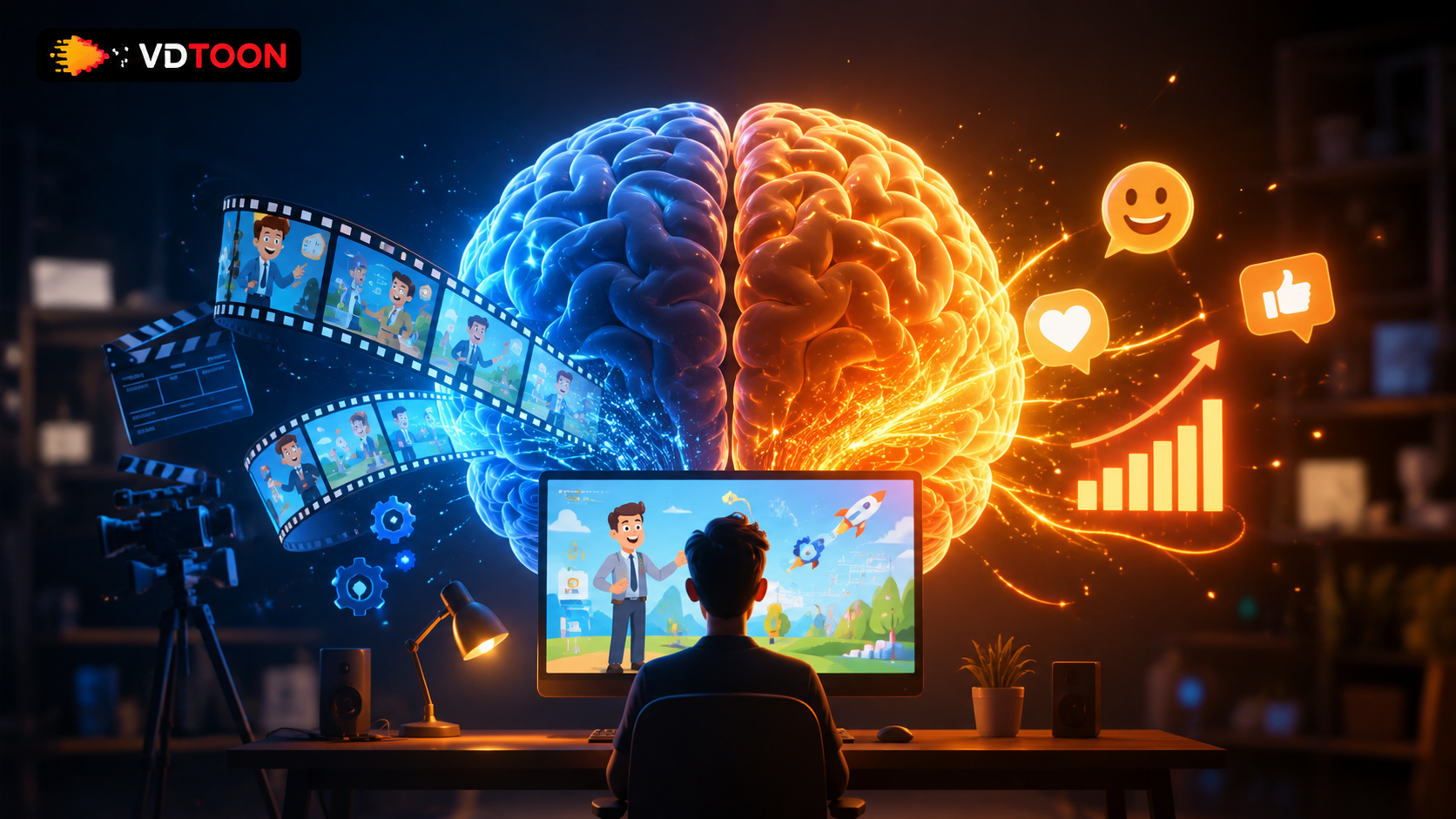
Then I actually started digging into the research, and it turns out the reasons are surprisingly grounded in how the human brain actually works. This isn't marketing fluff. There's real cognitive science behind why cartoons and animated explainers hold our attention in ways that talking-head videos often don't.

Humans are wired to track movement. It's an evolutionary thing. For most of human history, movement in your visual field meant something important was happening, so the brain learned to prioritize it automatically. Animation gives your brain a constant stream of motion to follow, which keeps your attention locked in even when the content itself is dense or technical.
But it goes beyond just movement. There's a concept in psychology called the pictorial superiority effect, which basically says that we remember pictures far better than words. When you combine visuals with narration, as animated videos do, you're hitting two memory pathways at once. Researchers call this "dual coding." The brain stores the visual version and the verbal version simultaneously, which means the information is more likely to stick and be recalled later.
This is one reason animated explainer videos tend to convert so well. The viewer isn't just hearing what your product does. They're seeing it, processing it on two levels at once, and walking away with a much clearer mental model than they would from a paragraph of text or even a live demo.
One of animation's biggest underrated strengths is that it lets you strip away everything that doesn't matter. In a live-action video, you're dealing with real environments, real faces, real backgrounds, real lighting. All of that visual noise competes for the viewer's attention, even subconsciously.
Animation lets you control exactly what's in the frame. You can make the relevant object glow, move the camera to focus on what matters, and eliminate visual distractions entirely. The result is that viewers can focus on the message without their brain working overtime filtering out irrelevant details.
There's a reason so many SaaS companies, fintech startups, and even healthcare brands default to animated explainers when they need to explain something complex. A 90-second animation can clarify something that would take a five-minute live walkthrough to explain, and the viewer usually feels less overwhelmed at the end.

Here's something I find genuinely interesting. Animation triggers emotional responses without the social awkwardness that sometimes comes with live video. When you're watching a real person on screen, part of your brain is automatically evaluating their body language and credibility, whether they seem nervous or rehearsed. It's largely unconscious.
With animation, that social evaluation layer disappears. You're left with just the story and the emotion the animation is designed to convey. Characters can be exaggerated, expressive, and playful in ways that real humans can't quite pull off without seeming overdone. This lowers resistance and makes viewers more receptive to the message.
It also explains why animated videos tend to feel less like ads. The cartoon aesthetic signals "this is going to be easy and maybe fun," which gets people past the mental guard that usually goes up when they sense they're being sold to.

There's a psychological concept sometimes called social currency, the idea that people share things that make them look good, interesting, or in-the-know. Animated videos tend to score well on this scale, especially when they're clever, visually distinct, or explain something people didn't know before.
A well-made animation also tends to feel more "produced" than a basic screen recording or talking-head clip, which makes people more comfortable sharing it. Nobody wants to forward something that looks rough or amateurish, even if the information is solid. Creating animations that look polished and intentional raises the perceived production value almost automatically, which directly feeds into sharing behavior.

All of this raises a practical question for anyone creating content or running a small business: how do you actually make animated videos without a design team or a big budget?
This is where tools like VidToon come into the picture. It's a desktop-based animation platform built for people who need to create animated explainer videos without learning a professional animation suite. You work with pre-built characters, scenes, and drag-and-drop elements, add voiceovers or music, and export a finished video. The learning curve is genuinely manageable, which matters when you're a solo creator or a small team trying to produce content consistently.
It won't replace a studio production, but for the kind of short-form explainer content that actually drives clicks and conversions, it covers a lot of ground. And given what we know about why animated video performs the way it does, even a simple, clean animation tends to outperform a polished live-action clip in engagement metrics.
The science isn't complicated once you lay it out. Animation works because it aligns with how human attention, memory, and emotion actually function. It reduces cognitive load, hits multiple processing channels at once, lowers viewer resistance, and makes content feel shareable. These aren't accidents of design. They're the predictable results of giving the brain exactly the kind of input it's built to respond to.
If you've been sitting on the fence about whether animated video is worth the effort, the research suggests the answer is pretty clearly yes. The brain doesn't lie, and it really does prefer a well-timed cartoon.



 Facebook
 Instagram
 Twitter
 Linkedin
 Youtube